In March 2020, the most-read article in the history of the Financial Times was a chart. The journalist John Burn-Murdoch's "trajectory" graphic, which plotted each country's COVID-19 cases on a logarithmic y-axis, let readers compare growth rates at a glance and drove a roughly 250 percent surge in traffic. It was a genuinely great chart. It was also built on a device that most of its audience could not actually read.
A logarithmic axis spaces its gridlines by multiples rather than amounts: ten, a hundred, a thousand, each the same distance apart. That has one strange consequence. Exponential growth, the kind that doubles on a fixed schedule, turns into a straight line. And a straight line that tilts gently upward does not look like a catastrophe. It looks like something under control.
This is not a cosmetic quibble. A randomized experiment found that the choice between a log and a linear axis measurably changed how well people understood the pandemic, how worried they were, and which policies they said they supported. And the same flattening trick is now quietly drawn under every AI and chip "growth" chart you have seen this year.
Same data, two axes
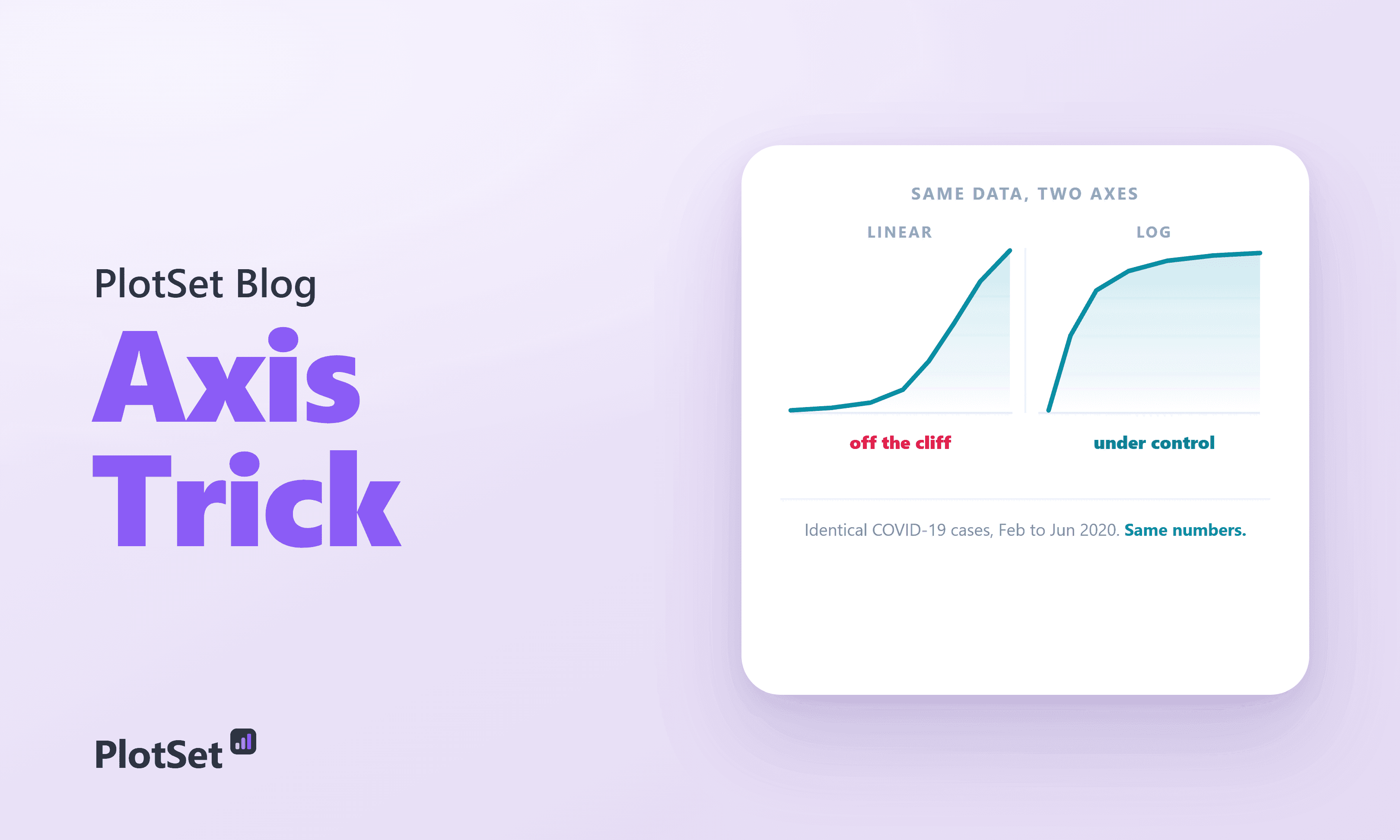
Start with the demonstration. Here is the United States cumulative case count from late February to June 2020, from 16 confirmed cases to nearly two million, drawn first on an ordinary linear axis.
That is the wall everyone remembers: flat through February, then a near-vertical cliff. Now here is the identical data, the same numbers on the same dates, drawn on a logarithmic axis.
The cliff is gone. The explosive phase is a tidy rising line that then bends and levels off, as if the worst were already behind us. The linear panel shows you the magnitude, how big, and the log panel shows you the rate, how fast it is compounding. Neither is lying. They are answering different questions, and most readers cannot tell which question they are looking at. (A footnote in the spirit of the topic: these are confirmed cases, which badly undercounted real spring-2020 infection because testing was scarce, and assembling even this clean series is easy to get wrong.)
What the experiment actually found
The strongest evidence that this matters comes from a pre-registered, double-blind randomized trial by Alessandro Romano, Chiara Sotis, Goran Dominioni and Sebastian Guidi, published in Health Economics in 2020. They showed 2,074 US adults the exact same COVID-19 death data, randomly assigning roughly half to a logarithmic version and half to a linear one, then asked a simple question: did deaths grow more in one week than the next?
Share who correctly read whether growth was speeding up or slowing down, on a log versus a linear axis, shown identical COVID data in a randomized trial (n=2,074). A 43-point gap.— 40.66% vs 83.79%
Comprehension nearly halved. On a neutral, non-COVID "Infection Z" graph the gap was even wider, which rules out the comforting idea that people were just confused about the virus rather than the chart. Even professional scientists are not immune: a separate study found ecologists read log-log graphs correctly only 56 percent of the time against 93 percent for linear. This is a design problem, not a stupidity problem.
The axis also nudged attitudes. Linear-scale viewers came away significantly more worried about the health crisis and forecast the coming week's deaths more accurately (a mean of 63,429 against the log group's 71,250; the real figure was 54,256). Here is where honesty demands a hard brake. These are stated attitudes, measured immediately after looking at one graph, on a non-representative online panel. The policy effects in the study were small and tangled, and a larger Canadian replication found no effect at all on support for lockdowns. The honest claim is that the scale changed comprehension, worry, and stated preferences. It is not that a chart changed how anyone voted.
Why we were primed to be fooled
The axis lands on a brain already wired to misjudge exponentials. Decades of "exponential growth bias" research show people instinctively flatten compounding into something closer to a straight line. In one classic finance result, 96 percent of subjects underestimated compound growth. Asked at the start of the pandemic to project 30 days of doubling-every-few-days case growth, 90 percent of people lowballed it, with a median guess around 15,000 when the correct answer was roughly a million. A log axis does not correct that bias. It draws a picture that confirms it, flattening the curve in exactly the place our intuition already wants it flat.
When the log axis is the right call
The fair version of this story is not "log axes are deceptive." A straight line on a semi-logarithmic chart is the mathematically correct, standard way to display constant-rate exponential growth, and often the only legible way to show data that spans many orders of magnitude. Push the critique too far and you lose real information: one experiment found that log scales actually help people predict where an exponential trajectory is heading, even as they hurt people's reading of individual values. The log axis is right for rate and wrong for level. The sin is not using one. The sin is using one alone, unlabeled, for an audience that reads it as if it were linear.
The same trick now hides the AI boom
This is not a pandemic curiosity, because the log axis is a general-purpose flattener. Sort the table below by how fast each thing doubles and you get a tour of modern exponentials, from compound interest doubling every decade to COVID cases doubling every three days. Every single one of them becomes a calm straight line the moment you switch to a log axis.
The most consequential entry on that list right now is artificial intelligence. By Epoch AI's accounting, the compute used to train frontier models has been doubling roughly every five months, a rise of about 10,000-fold since 2020. Plotted honestly on a linear axis, almost the entire history would be an invisible flat line hugging zero until a final vertical spike. So nobody plots it that way.
Growth in frontier AI training compute, doubling roughly every five months. Every chart you see of the AI boom uses a log axis, which is correct and also perceptually soothing. — ~10,000x since 2020
Nine orders of magnitude, from AlexNet to the latest frontier models, rendered as an orderly stroll uphill. The same device that made March 2020 look survivable now makes a billion-fold explosion in compute look like a tidy trend. In fairness, even this curve should be read with care: Epoch estimates that the very latest models may be bending the trend, so the log axis is not the only thing worth doubting.
The fix is not to ban the log axis
Visualization researchers broadly agree on three corrections, none of which is "never use log." First, label the logarithmic axis loudly and say what it means, because a quiet "log scale" in eight-point type is not enough. Second, show a linear version alongside it, or let the reader toggle between them, the way the best 2020 trackers did. Third, plot the daily growth rate or new cases directly, so that a real slowdown shows up as a falling line instead of a subtle change in the bend of a smoothed curve. Romano and his coauthors put it plainly: for a general audience, default to linear, or at least show both.
An axis is an argument. Choosing log or linear is choosing whether to emphasize how fast something is growing or how big it has become.
A reader who cannot see that choice cannot push back on it. The honest move, almost always, is to stop making the reader guess and simply show them both.
Sources & further reading
- Romano, Sotis, Dominioni & Guidi (2020), Health Economics. The scale of COVID-19 graphs affects understanding, attitudes, and policy preferences. Pre-registered double-blind RCT, n=2,074; identical COVID death data on a log vs linear axis.
- LSE COVID-19 blog. The public doesn't understand logarithmic graphs often used to portray COVID-19. 40.66% (log) vs 83.79% (linear) correct; worry and death-forecast results.
- Sevi et al. (2020). Logarithmic versus linear visualizations. Null replication, n=2,500 (Canada); no significant effect of scale on confinement support.
- Menge et al. (2018), Nature Ecology & Evolution. Logarithmic scales in ecological data presentation may cause misinterpretation. Ecologists read log-log graphs correctly 56% vs 93% linear.
- Ciccione, Melnik-Leroy et al. (2023). Log scales and exponential-trajectory prediction. Log scales aid prediction even as they hurt value-reading.
- Schonger & Sele (2020), PLOS ONE. How to better communicate the exponential growth of infectious diseases. ~90% underestimated 30-day case growth (median 15,000 vs ~1,000,000).
- Levy & Tasoff. Exponential-Growth Bias. 96% of subjects underestimate compound growth.
- Epoch AI. Machine learning trends. Frontier training compute doubling ~5 months, ~10,000x since 2020.
- Our World in Data. COVID-19 JHU-archive case data. The US cumulative-case series used in the two-panel demo.
- Nightingale. How John Burn-Murdoch's dataviz helped the world understand coronavirus. The FT log trajectory chart and its reach.
- Poynter. How charts and graphs could be influencing our pandemic reactions. The hypothetical-graph comprehension gap and context.
- Aatish Bhatia. Covid Trends. A log-log tracker built to show rate, with linear toggles.