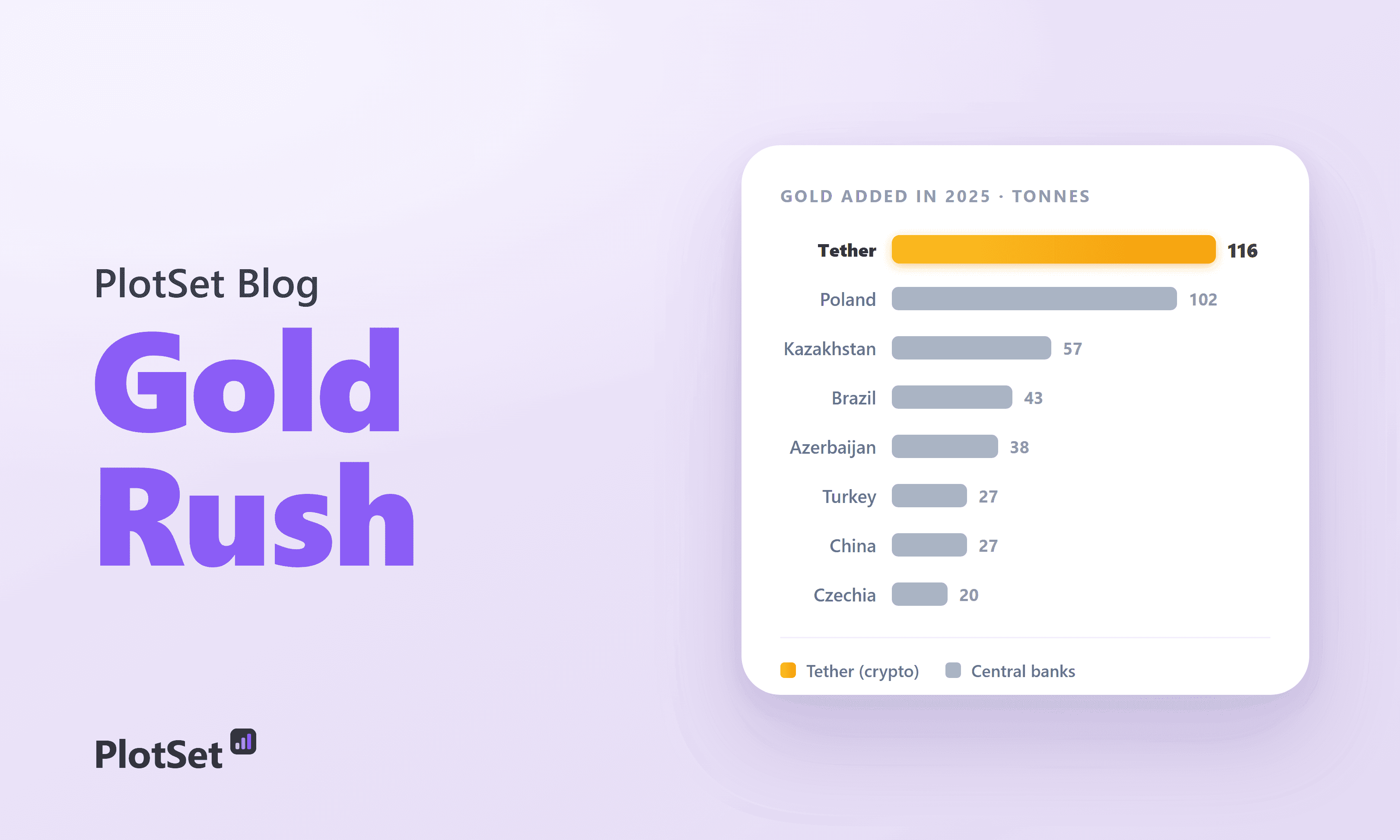
For as long as anyone has kept score, the biggest buyers of gold have been nation-states. Central banks hold it as the ultimate reserve, the asset that answers to no other country's politics. So when the league table of the world's largest gold buyers came out for 2025, one name at the top did not belong. It was not a country at all. It was Tether, the company that prints the USDT stablecoin.
This is not a crypto blog's wishful framing. The European Central Bank said it, in writing. In its June 2026 report on the international role of the euro, the ECB noted that Tether had become an even larger purchaser of gold than any central bank, adding more than 100 tonnes in 2025 and edging out Poland, the year's top sovereign buyer. A private crypto firm out-bought every individual central bank on Earth. That is the headline, and it is true. The honest version, the one most coverage skips, comes with a catch we will get to.
The league table nobody expected
Sort the table below by tonnes and the strangeness is immediate. Tether sits at the top with roughly 116 tonnes, above Poland's 102, then the familiar roll call of official-sector buyers: Kazakhstan, Brazil, Azerbaijan's sovereign fund, Turkey and China tied, the Czech Republic, on down to a couple of central banks that were net sellers last year.
What makes it land is the company in the room. Every other entry is a state or a sovereign wealth fund, institutions that buy gold to defend a currency or a budget. The one outlier is a firm most people associate with a digital token that is supposed to be worth exactly one dollar. It is now buying bullion at the pace of a top-tier nation.
Against the busiest gold decade in history
Here is what makes the feat stranger, not less so. Central banks have spent the last few years buying gold like the monetary order depended on it, and the chart below shows the scale of that spree.
For most of the 2010s, the official sector added a few hundred tonnes a year. Then, after 2022, net purchases blew past 1,000 tonnes and stayed there for three straight years. 2025 was actually a cooling-off: net central-bank buying fell to 863.3 tonnes, down about a fifth from 2024's record, but still the fourth-largest year ever recorded. Tether topped that field. Not in a quiet year for gold, but against the heaviest stretch of sovereign accumulation in modern history.
Every central bank on Earth bought 863.3 tonnes of gold on a net basis in 2025. Tether, alone, added around 116, more than any single one of them.— 863.3 t vs ~116 t
Why a stablecoin issuer is hoarding bullion
The obvious question is why a company that issues a dollar token needs a vault full of metal. The answer is on its balance sheet, broken out in the chart below.
Tether ended 2025 with roughly $193 billion in assets, the bulk of it in US Treasuries, alongside about $17.4 billion in gold and $8.4 billion in Bitcoin. Gold is not the core backing for USDT. It is roughly a tenth of the pile, a deliberate diversification of the profits the company is throwing off, and those profits are enormous: Tether reported more than $10 billion in net income for 2025, which buys a lot of metal. Chief executive Paolo Ardoino has described a gold-and-Bitcoin strategy and a pace of up to $1 billion of gold a month, stored in a Swiss bunker.
There are really two gold pools here, worth keeping straight. One sits inside Tether's own reserves and profit. The other backs a separate token, Tether Gold, whose physical holdings reached 16.2 tonnes at the end of 2025. There is a regulatory wrinkle too: under the new US GENIUS Act, gold cannot legally back a payment stablecoin, so none of this metal is propping up the dollar peg. It is a corporate treasury hedging itself.
Gold's once-in-a-generation year
It also helped that Tether was buying into the best gold market in a lifetime, as the chart below makes plain.
Gold opened 2025 near $2,600 an ounce and closed the year around $4,310, a gain of roughly 65 percent, its sharpest annual run since 1979. The momentum carried into the new year, when bullion cleared $5,000 for the first time in January 2026 before peaking near $5,589 and then giving back a chunk in a spring correction. By the ECB's accounting, gold had overtaken US Treasuries to become the single largest reserve asset on the planet. One consequence worth flagging: a good part of the dollar value of Tether's hoard reflects this price surge, not only the new metal it carried into the vault.
The catch the headlines skip
Now the honesty. The comparison that makes the headline is not strictly like-for-like, and a careful reader deserves to know why. Central-bank figures from the World Gold Council are net: purchases minus sales, plus an estimate for buying that governments never report. Tether's number is gross, additions to a corporate balance sheet with no disclosed sales. So the table flatters Tether a little: its roughly 116 tonnes is a gross figure sitting next to Poland's 102 tonnes of net buying, and on a like-for-like basis the two are far closer, plausibly neck and neck.
Tether out-bought every individual central bank. It did not out-buy all of them combined, which together added 863 tonnes, roughly eight times its haul.
So the accurate claim is narrower than the slogan: Tether was the largest single gold buyer of 2025, not a one-company replacement for the world's central banks. Quarter by quarter, a single bank sometimes beat it outright. The crown is real, but it sits on one head among many, not above the whole field at once.
Why it matters anyway
Even fully caveated, the story is a genuine shift, and that is the part to sit with. A corporate treasury is now accumulating gold at the rate of a top-five nation, and doing it because a stablecoin business has become one of the most profitable enterprises in finance. The clearest sign yet is that the list of entities big enough to move the gold market has quietly grown by one, and that the newest member answers to shareholders, not voters. Central banks built their reserves over centuries to stand outside the market. A crypto company just walked into the same room, checkbook open, in a single year.
The next time gold makes a record, do not assume it was a nervous nation doing the buying. It might have been a company that started life making a one-dollar token.
Sources & further reading
- European Central Bank. The International Role of the Euro (June 2026). Tether added more than 100 tonnes of gold in 2025, exceeding top central-bank buyer Poland; gold reached ~27% of global official reserves, overtaking US Treasuries.
- World Gold Council. Gold Demand Trends FY2025, Central Banks. The 2025 central-bank league table (Poland 102t, Kazakhstan, Brazil, etc.) and net/gross/unreported methodology.
- World Gold Council. Gold Demand Trends FY2025. Total central-bank net purchases of 863.3 tonnes in 2025 (down ~21% from 2024's 1,092.4t); total gold demand above 5,000t for the first time.
- Visual Capitalist. A Decade of Central Bank Gold Purchases (WGC data). Annual net central-bank purchases through the 2010s and the post-2022 surge above 1,000t.
- CoinDesk. Tether's gold stash tops $23 billion as buying outpaces nation-states (Jefferies). Tether's gold (
$17.4B) and Bitcoin ($8.4B) reserve line items; total gold ~148t by Jan 2026. - CoinDesk. Tether is buying up to $1 billion of gold per month. Ardoino's gold strategy, monthly buying pace, Swiss bunker storage.
- Kitco / Jefferies. Tether's gold purchases could support prices for years. The range of analyst estimates for Tether's quarterly gold buying.
- Tether. Tether delivers $10B profits in 2025. $10B+ net profit, ~$193B total assets, record $141B Treasury exposure.
- Tether. Tether Gold (XAUT) surpasses $4 billion. XAUT physical backing of 16.2 tonnes at end-2025.
- BullionVault. Gold & silver 2025 record price. Gold's ~65% gain in 2025 to a ~$4,310 year-end close.
- CNBC. Gold surges past new $5,000 record. Gold clearing $5,000/oz in January 2026.
- State Street Global Advisors. GENIUS Act explained. US stablecoin reserve rules, under which gold cannot back a compliant payment stablecoin.