Every dashboard has a bar labeled "average." Average revenue per user, average session length, average basket size. It feels like the safest number in the room, the one that describes the typical person. It usually describes no one at all.
The best proof of that is seventy years old, and it comes from a runway. In the late 1940s the US Air Force had a crisis: its planes were crashing, often with no mechanical fault and no pilot error. The cockpits had been built in the 1920s to fit the average pilot, sized from an earlier survey. The Air Force assumed pilots had simply gotten bigger, so in 1950 it ran the largest body survey it had ever attempted, measuring more than 4,000 pilots, and prepared to rebuild the cockpit around the new average.
A 23-year-old researcher named Gilbert Daniels asked a question nobody had thought to ask: does the average pilot actually exist?
Zero out of 4,063
Daniels took the 4,063 pilots and picked the 10 body dimensions most relevant to cockpit design, height, chest, arm length, and so on. Then, being deliberately generous, he counted a pilot as "approximately average" on a dimension if they fell in the middle 30 percent of the range, a wide band, not a narrow slice. He asked how many pilots were average on all ten at once.
The chart above is his answer. On stature alone, 1,055 of the 4,063 pilots qualified, about a quarter. Add a second dimension and it dropped to 302. By the third, just 143 pilots, 3.5 percent, were still in the band. The count fell to 73, then 28, 12, 6, 3, 2, and after the tenth dimension it hit exactly zero. Out of 4,063 pilots, not one was average across all ten. The cockpit built for the average pilot fit nobody.
Pilots who were "average" (middle 30% band) on all ten cockpit dimensions. The average pilot the Air Force was designing for did not exist.— 0 of 4,063
Why "average" evaporates
This is not a quirk of pilots. It is arithmetic, and it starts with a single dimension.
Take height on its own, here for a modern anthropometric sample of over 4,000 people. It forms a tidy bell, but notice that even the tallest bar, the single most common five-centimeter band, holds only about 27 percent of men. Being "average height" already means being in a minority. And every dimension has its own wide spread, as the dot-plot below lays out.
Each of these ten dimensions ranges across many centimeters from the 5th to the 95th percentile, waist circumference alone spans about 36. To be "average" on all ten simultaneously, a person has to land in the narrow middle band of every one of them at the same time. Because the dimensions are not perfectly linked, the odds multiply down toward nothing. That is why the count collapses to zero. The average is not a person; it is a coordinate where no one is standing.
Every real person is jagged
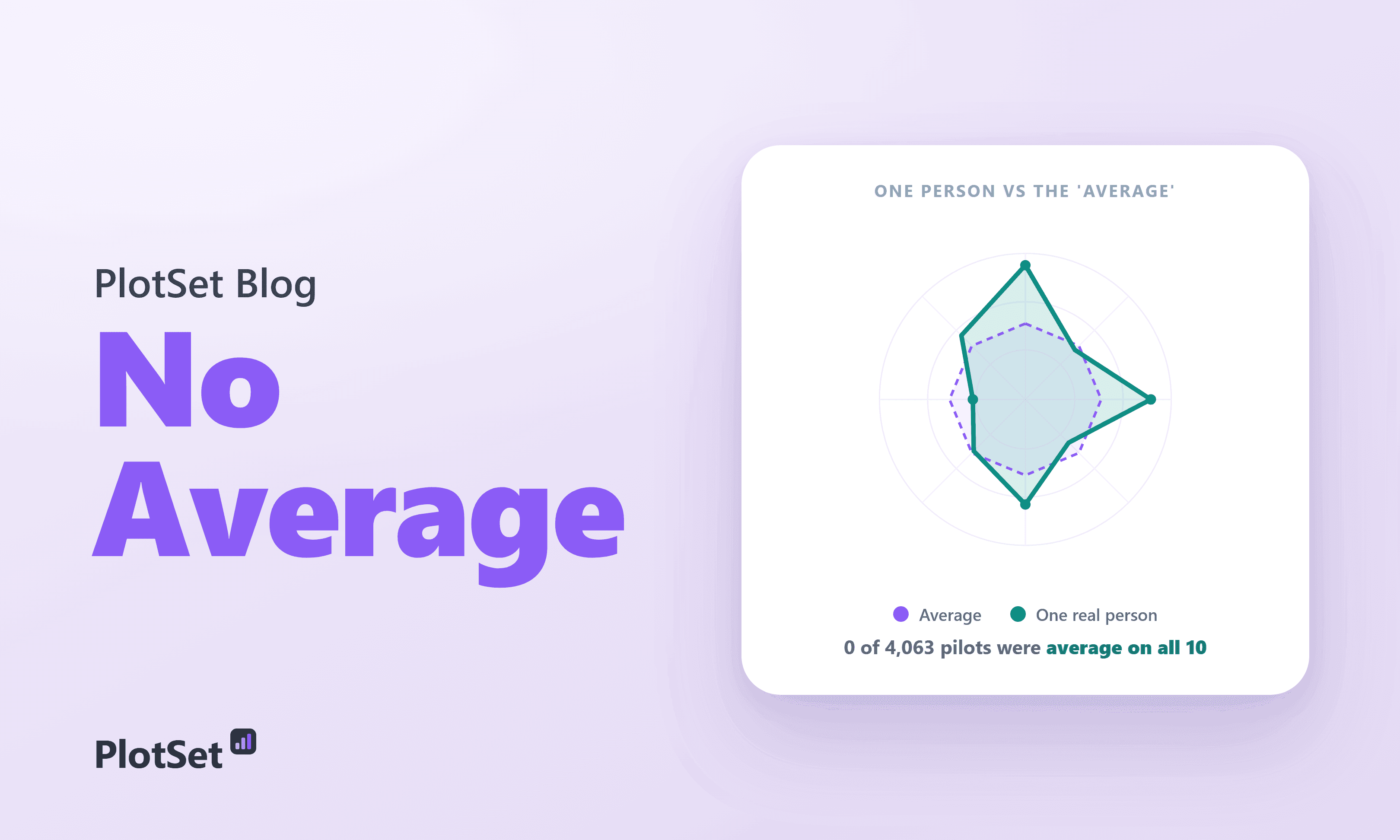
Picture one actual human being plotted against the average on every axis.
The "average" is the flat ring, the same middle value on every dimension. A real person is the jagged shape, long in the arms but narrow in the chest, tall but short-waisted. This particular profile is illustrative, but the shape is universal: everyone is above average on some dimensions and below on others, and no one traces the circle. Design for the circle and you have designed for the one shape that does not exist.
The average is not a person. It is a coordinate where no one is standing.
The fix that changed design
The Air Force's response is why this story is told at all. Instead of chasing a better average, it did something radical: it banned the average as a design target and mandated that cockpits accommodate pilots from the 5th to the 95th percentile on every dimension. Engineers protested that it was impossible and expensive, until the obvious solution appeared, adjustable seats, adjustable pedals, adjustable helmet straps. The adjustable seat in your car descends directly from this decision. "Designing to the edges," giving the individual room to fit themselves rather than forcing them to match a mean, became a design philosophy. (The vivid claims that "planes stopped crashing overnight" are narrative flourish; the real, multi-decade decline in accident rates owed plenty to better engines, training, and ejection seats too.)
The ghost is everywhere
Once you see it, the phantom average turns up in every domain that matters.
US average household income was about $121,000 in 2023, but the median was $80,610, because a right-skewed distribution pulls the mean above roughly two-thirds of households. The top ten prescription drugs in America help as few as 1 in 25 of the people who take them, because "works on average" hides a sea of non-responders. Crash-test protection was long tuned to a 50th-percentile male dummy, and belted women turned out to face about 47 percent higher odds of serious injury in comparable crashes, a figure that is directionally real even if partly confounded by which cars people drive. Pulse oximeters calibrated mostly on light skin miss dangerously low oxygen roughly three times more often in Black patients. A facial-analysis system that was 99 percent accurate overall misclassified 34.7 percent of darker-skinned women. The sleeping pill Ambien was sold at one dose until the FDA cut it for women, who clear the drug far more slowly. In every case the aggregate was reassuring and the individual was harmed.
Pooling groups makes the ghost worse, not better, as the chart below shows.
Average the sexes together and you invent an "average person" taller than most women and shorter than most men, someone who is nobody. And the differences are not even consistent: across most dimensions men are larger, but hip breadth reverses, with the female mean slightly larger. An "average human" smooths all of that into a single fiction.
When the average is fine
None of this means the mean is a bad statistic. For aggregates and totals, national income, total demand, the expected value of a bet, you cannot substitute anything else, and pooling is exactly the point. For one roughly symmetric variable, like height within a single sex, the mean is an honest and efficient summary. The error is not using averages. It is designing FOR the average, treating a summary of a crowd as a portrait of a person, then building a cockpit, a car, a drug dose, or a product around that portrait.
So before you trust an "average" bar, ask two things: is this distribution skewed, so the median tells a different story? And am I combining dimensions, where being typical on all of them at once describes almost no one? If either answer is yes, you are charting Daniels' ghost. Design for the range of people who are actually there.
Sources & further reading
- Gilbert S. Daniels. The "Average Man"?, WADC Technical Note (1952). 4,063 pilots, 10 dimensions, zero average on all ten; the decay chain.
- Wright Air Development Center. Anthropometry of Flying Personnel, 1950 (WADC TR 52-321). The underlying Air Force survey of 4,000+ pilots.
- Todd Rose / Harvard GSE. Beyond Average. The story's retelling and the 5th-95th percentile accommodation mandate.
- Reading By Eugene. The End of Average, band definition (excerpt). "Average" defined as the middle ~30% of each dimension's range.
- Gordon et al. ANSUR II: Anthropometric Survey of U.S. Army Personnel (2012). Modern body-dimension distributions and percentiles.
- RAND. Trends in U.S. Air Force Aircraft Mishap Rates. The long, multi-causal decline in accident rates.
- U.S. Census Bureau. Income in the United States: 2023. Median household income $80,610 vs the higher mean.
- Schork. Personalized medicine: Time for one-person trials, Nature (2015). Top drugs help as few as 1 in 25 patients.
- Bose, Segui-Gomez & Crandall. Vulnerability of female drivers, AJPH (2011). Belted women's 47% higher odds of serious injury.
- IIHS. Vehicle choice and crash differences explain greater injury risks for women. The confound behind the gap.
- Sjoding et al. Racial bias in pulse oximetry measurement, NEJM (2020). Misses low oxygen ~3x more often in Black patients.
- Buolamwini & Gebru. Gender Shades, MIT Media Lab (2018). 34.7% facial-analysis error for darker-skinned women.
- FDA. Lower recommended zolpidem (Ambien) dose for women. Women clear the drug ~50% slower.