What Four Decades of Global Data Reveal About Systemic Fragility
In 1980, an estimated 553,569 people died by suicide worldwide. In 2023, the number reached 767,616.
The surface reading suggests steady deterioration. More deaths. More despair.
That interpretation is wrong.
Across four decades, global suicide has not climbed in a straight line. It has risen sharply, fallen for more than a decade, stabilized, and then risen again. The curve bends around economic collapse, political disintegration, public health reform, demographic aging, and finally a pandemic that destabilized mental health across continents.
Suicide does not drift randomly. It moves with systemic stress.
The Arithmetic Trap
Absolute deaths increased by more than 200,000 between 1980 and 2023. But during that period the global population expanded dramatically and aged. Older populations carry higher suicide risk in most regions. Even flat or declining rates can produce large absolute totals when populations grow.
If one ignores demography, one misreads the story.
The real question is not whether humanity has become more fragile. It is why the curve accelerates after structural shocks and recedes when institutions stabilize.
1980 to 1994: Instability and Escalation
The early 1980s were defined by oil shocks and recession. Economic contraction consistently correlates with suicide increases. Unemployment, debt pressure, and status loss are measurable risk multipliers. The decisive rupture came in the early 1990s. The collapse of the Soviet Union triggered mass unemployment, social dislocation, and surges in alcohol consumption across Eastern Europe. Alcohol is one of the strongest population level suicide risk amplifiers documented in epidemiology.
By 1994, global suicides reached 783,724, a dramatic rise from 1980.
In parallel, parts of East Asia faced intense economic volatility during the 1997 to 1998 financial crisis. Suicide rates spiked sharply in several affected economies. By 2000, the global total peaked at 819,534.
The pattern is consistent. When economic and political systems fracture, suicide rises.
2001 to 2016: A Counterintuitive Decline
After 2000, the curve turned downward. Despite the 2001 downturn and the 2008 global financial crisis, global suicide deaths declined steadily. By 2015 and 2016, totals fell to roughly 726,000.
This decline is one of the most important facts in the dataset.
Several structural forces converged.
China experienced a sustained reduction in suicide rates, particularly in rural regions. Urbanization, economic mobility, and restrictions on access to highly lethal pesticides reduced national mortality. Given China’s population weight, this alone shifted global totals.
High income countries expanded antidepressant use and institutionalized suicide prevention strategies. Mental health care moved from stigma to policy. Means restriction, especially pesticide and firearm controls in some regions, demonstrated measurable population level effects.
Even the 2008 financial crisis, which produced localized increases, did not reverse the global downward trajectory.
This period proves something uncomfortable but critical. Suicide is highly sensitive to policy and environment. It is not an immutable constant.
2017 to 2019: Gradual Reversal
After bottoming out, the numbers began to climb again. 2018 recorded roughly 732,320 deaths. 2019 reached approximately 736,949.
No single global recession explains this. Instead, the rise reflects distributed pressures. Opioid epidemics in North America. Youth mental health deterioration in several Western countries. Rising economic precarity. Intensified social comparison in digital environments.
The increase was not explosive. It was structural and gradual. The resilience of the early 2000s had weakened.
2020 to 2023: Pandemic Shock and Delayed Impact
When COVID 19 began, fears of immediate suicide surges did not uniformly materialize. Emergency income supports and collective crisis psychology may have buffered short term effects.
But psychological deterioration was measurable. The World Health Organization reported a 25 percent global increase in anxiety and depression prevalence during the first year of the pandemic.
Distress accumulates before it converts to mortality.
The data shows: 2020 approximately 735,995 2021 approximately 759,370 2022 approximately 771,497 2023 approximately 767,616
The peak in 2022 suggests delayed systemic impact. Isolation, bereavement, disrupted education, healthcare strain, and economic uncertainty do not resolve quickly.
The slight decline in 2023 may indicate stabilization. It may also represent statistical fluctuation. It is too early to conclude recovery.
The Structural Law
Across forty three years, the same rule appears repeatedly:
Economic collapse increases suicide.
Political disintegration increases suicide.
Alcohol and substance surges increase suicide.
Access to lethal means increases suicide.
Coordinated prevention, economic mobility, and institutional stability reduce suicide.
This aligns with the sociological insight first articulated by Émile Durkheim, who argued that suicide reflects levels of social integration and regulation. Modern data confirms the principle at global scale.
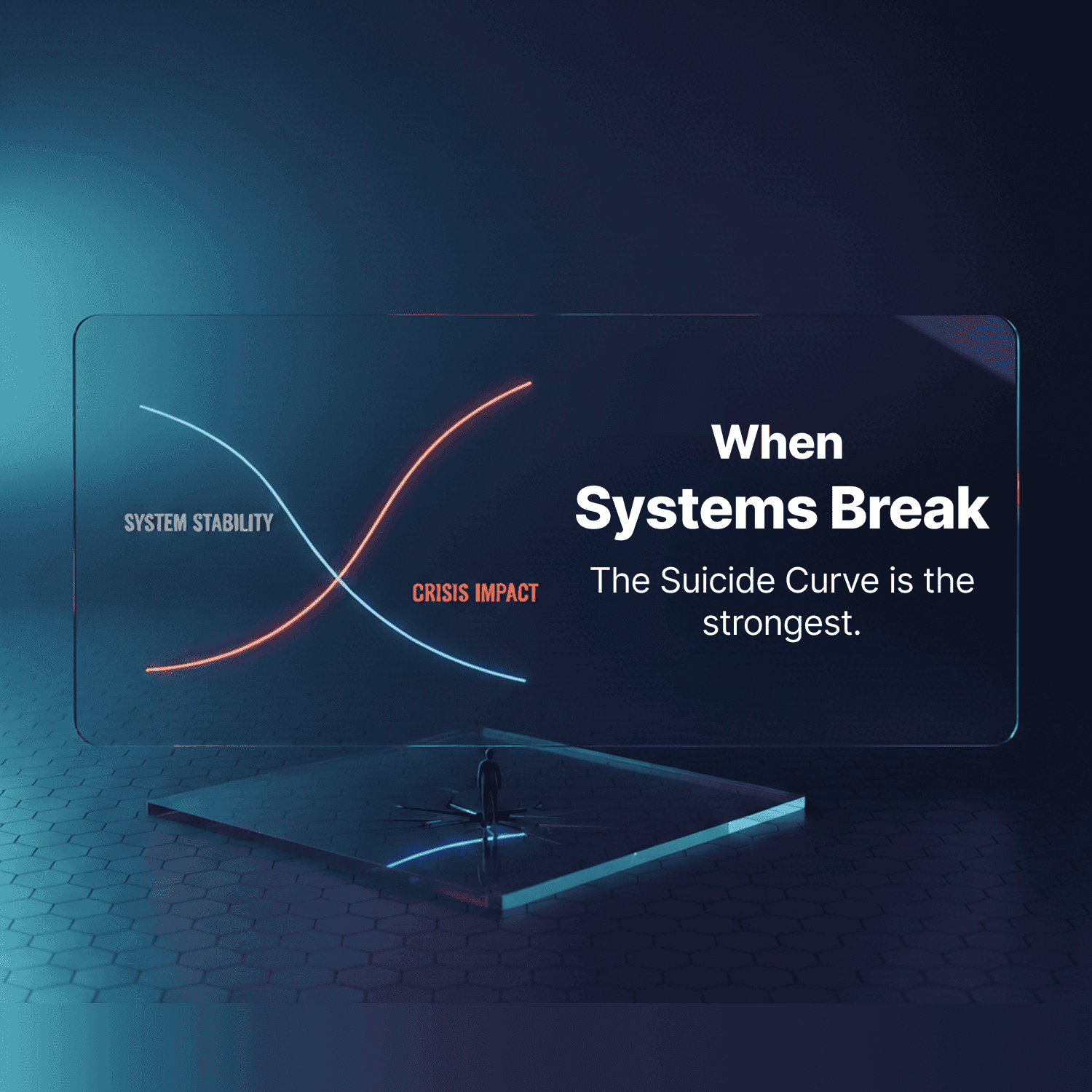
Suicide tracks the stability of systems.
The Hard Conclusion
From 553,569 deaths in 1980 to 767,616 in 2023, the long arc is not one of linear despair. It is a sequence of stress reactions.
The decline between 2000 and 2016 demonstrates that large scale reduction is possible. The rebound after 2017 and especially after 2020 demonstrates that progress is reversible.
Even if global rates fall modestly in coming years, absolute deaths may remain high because populations continue to grow and age. Demography alone will sustain large totals.
The past four decades reveal a blunt reality. Suicide is not simply an individual mental health issue. It is a systemic indicator. When economic, political, and social institutions destabilize, mortality responds.
The next major shock is not hypothetical. History suggests it is inevitable. The only open question is whether global systems will absorb it or amplify it.
That will determine the next movement of the curve.