Plastic is not the villain of the modern world. It is one of its foundations.
From sterile surgical instruments to lightweight aircraft components, from food preservation to digital infrastructure, plastic has enabled longevity, affordability, and safety at a scale no other material has matched. In 1950, the world produced two million tonnes of plastic. Today, annual production exceeds 450 million tonnes. In just seventy years, output has increased nearly 230-fold. In the last two decades alone, it has doubled.
This trajectory is not an accident. It is the material signature of industrial acceleration, urbanization, globalization, and rising incomes. Plastic is cheap, versatile, and durable. It is precisely these qualities that make it indispensable to modern economies and destructive when mismanaged.
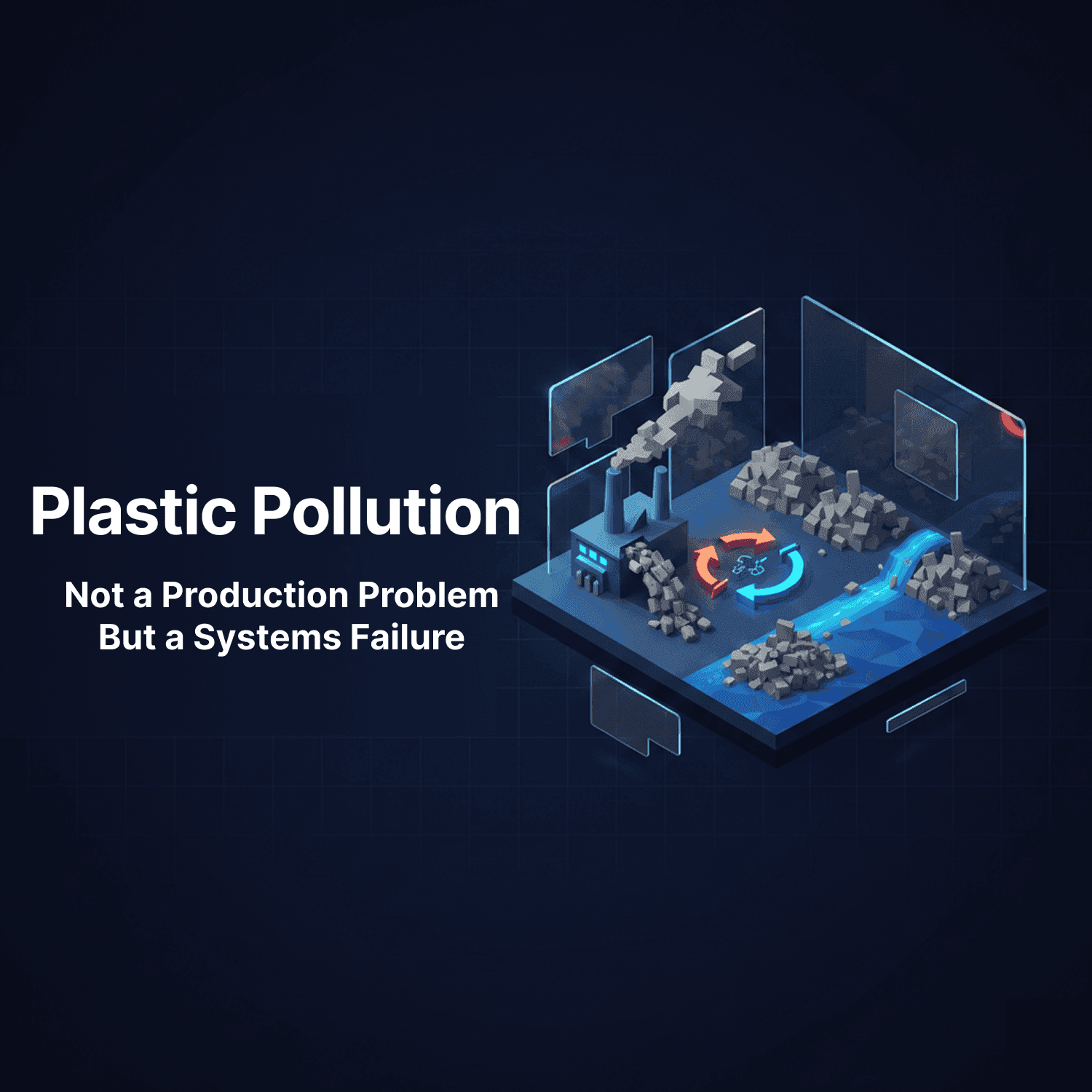
The central fact that reshapes the entire debate is this: plastic pollution is mostly not about how much plastic we produce. It is about how we manage what we discard.
The Production Surge
The modern plastics industry began in 1907 with Bakelite, the first synthetic polymer. But exponential growth did not begin until the 1950s, when petrochemical expansion, consumer goods manufacturing, and global trade converged. Since then, plastics have penetrated nearly every sector: construction, automotive manufacturing, medicine, electronics, textiles, and food systems.
Between 2000 and 2019, global plastic production doubled. Population growth explains part of this increase, but not all. Per capita plastic use has also risen, particularly in high-income countries. Wealth correlates strongly with plastic consumption. Americans and Western Europeans generate several times more plastic waste per person than citizens of India or Ethiopia.
Yet here is where intuition fails.
High plastic use does not automatically translate into high plastic pollution.
Waste vs. Pollution: A Critical Distinction
Plastic waste refers to discarded material. Plastic pollution refers to waste that escapes controlled systems and enters the environment through open burning, dumping, leakage into rivers, or dispersal as debris.
When we compare countries by plastic waste per capita and plastic pollution per capita, the relationship collapses. Wealthy countries generate far more waste per person. But they leak almost none of it.
In high-income economies, waste collection rates are near universal. Landfills are sealed. Incineration is regulated. Recycling infrastructure, while imperfect, functions at scale. As a result, per capita plastic pollution in these countries is close to zero.
In contrast, low- and lower-middle-income countries generate far less plastic waste per person. Yet they produce dramatically higher plastic pollution.
The average person in a low-income country generates more than 50 times the plastic pollution of someone in a high-income country. This occurs despite producing roughly four times less plastic waste overall.
The explanation is structural: inadequate waste management systems.
Where waste is not collected, it accumulates in open dumps. Where dumps are unregulated, plastics are burned in the open, releasing toxic air pollutants. Where drainage systems are unmanaged, debris flows into rivers. Where coastlines are densely populated without infrastructure, plastics move quickly into marine ecosystems.
The crisis is not primarily a consumer morality problem. It is an infrastructure deficit.
The Ocean Myth and the 0.5% Reality
Public perception often imagines vast quantities of global plastic production pouring directly into the sea. The reality is more nuanced.
The world generates roughly 350 million tonnes of plastic waste annually. Of this, recent high-quality estimates suggest that between one and two million tonnes enter the oceans each year. That equates to roughly 0.5 percent of global plastic waste.
This number is simultaneously reassuring and alarming.
It is reassuring because it reveals that the overwhelming majority of plastic waste does not end up in the ocean. It is alarming because even half a percent, at current scale, equals millions of tonnes entering marine systems annually.
Approximately one-quarter of global plastic waste is mismanaged. Only a fraction of that mismanaged waste reaches the ocean. Whether it does depends on geography: river density, rainfall patterns, topography, proximity to coasts, and urban layout all influence leakage probability.
Earlier estimates suggested that as much as eight million tonnes entered the oceans annually. Newer modeling indicates lower figures, likely around one to two million tonnes. But uncertainty remains high. Measurement is complex. Plastic fragments degrade, sink, or disperse.
Even at the lower bound, the ecological consequences are severe.
Geography of Responsibility
Most ocean plastics originate from middle-income countries, particularly in Asia.
This is not a narrative of blame. It is a demographic and economic reality.
Many middle-income countries are undergoing rapid urbanization and consumption growth. Plastic use is rising faster than waste infrastructure can scale. Informal waste sectors, open dumps, inadequate collection coverage, and underfunded municipal systems create systemic leakage.
River systems in densely populated regions transport mismanaged waste efficiently to coastal zones. Once in the ocean, plastics accumulate along shorelines or enter gyres where they fragment into microplastics.
High-income countries historically exported significant volumes of plastic waste, further complicating responsibility. However, the dominant variable today is domestic waste management capacity within rapidly developing economies.
The global pattern is clear: production is global, but pollution is concentrated where infrastructure is weakest.
Environmental and Biological Consequences
The consequences of plastic leakage extend across ecological, biological, and economic domains.
Marine Ecosystems
Large plastic debris entangles marine mammals, seabirds, and turtles. Ingestion causes intestinal blockage, starvation, and internal injury. Coral reefs become physically smothered. Fisheries suffer contamination and gear damage.
Microplastics
As plastics fragment, they form microplastics and nanoplastics. These particles now permeate oceans, freshwater systems, soil, air, and human tissue. Microplastics have been detected in blood, lungs, and placental tissue. Long-term health impacts remain under investigation, but early evidence suggests potential inflammatory and endocrine-disrupting effects.
Toxic Air Pollution
In many low-income regions, plastic waste is openly burned. This releases dioxins, furans, and other toxic compounds linked to respiratory disease, cancer risk, and developmental harm. In some contexts, plastic burning is a major contributor to urban air toxicity.
Economic Damage
Tourism declines in polluted coastal areas. Fisheries face stock impacts and contamination risks. Municipalities incur escalating cleanup costs. The long-term economic burden compounds over decades.
Plastic pollution is not merely aesthetic degradation. It is a multi-layered environmental and public health issue.
What Happens If Nothing Changes?
If global plastic production continues its upward trajectory without proportional investment in waste management infrastructure, several outcomes are likely:
1. Absolute Ocean Inflow Increases Even if the percentage entering the ocean remains near 0.5 percent, rising total waste volumes will increase absolute leakage.
2. Microplastic Saturation Intensifies Fragmentation accumulates over time. Plastics persist for centuries. Environmental concentrations will compound.
3. Air Pollution Burden Grows in Developing Cities Open burning will expand unless formal systems replace it.
4. Inequality Deepens Environmental harm will disproportionately affect countries with the least fiscal capacity to manage it.
5. Regulatory Fragmentation Nations may impose unilateral bans or trade restrictions, disrupting global supply chains without addressing root infrastructure gaps.
The crisis will not explode suddenly. It will accumulate structurally.
The Real Leverage Points
The data suggests that dramatic reductions in plastic pollution do not require eliminating plastic itself. They require eliminating mismanagement.
Key leverage points include:
-
Universal waste collection systems
-
Sealed sanitary landfills
-
Controlled incineration with emissions treatment
-
Investment in sorting and recycling infrastructure
-
Formalization of informal waste sectors
-
River interception systems in high-leakage basins
-
Targeted infrastructure finance for middle-income urban regions
The cost of such interventions is significant but finite. Compared to the trillions embedded in global petrochemical production and consumer goods markets, upgrading waste systems is economically feasible.
Plastic pollution is solvable because high-income countries have already demonstrated near-zero leakage outcomes. The challenge is scaling that success globally.
A Structural, Not Moral, Crisis
Plastic is not disappearing. Demand for medical sterility, lightweight transport, food preservation, and consumer goods will not reverse in a world of growing population and rising incomes.
The path forward is not romantic anti-plastic absolutism. It is systems engineering.
The narrative must shift from production volume panic to infrastructure realism. Production matters for climate and fossil fuel dependence. But pollution is overwhelmingly a management failure.
The data makes this unambiguous.
Half a percent of global plastic waste reaches the ocean. That fraction reflects systemic weaknesses, not inevitability. Where governance, infrastructure, and regulation function, leakage collapses toward zero.
The future of plastic pollution will not be decided in petrochemical plants. It will be decided in municipal budgets, urban planning offices, waste collection routes, river basins, and development finance institutions.
Plastic pollution is not an unsolvable byproduct of modernity. It is a measurable, geographically concentrated, infrastructure-driven problem.
And infrastructure, unlike chemistry, can be built.