Executive Summary
Pie charts aren't just an aesthetic choice; they are a lower-fidelity perceptual instrument because human brains struggle to decode angles and areas accurately. In high-stakes decision environments where a 2% difference in market share matters, that extra perceptual "noise" becomes a measurable risk factor for misinterpretation and ultimately, for marginal capital misallocation.
The Science of "Visual Noise"
When an executive looks at a dashboard, they aren't just seeing colors; their brain is performing complex psychophysical calculations. Decades of controlled experiments, originating with classic studies by William S. Cleveland and Robert McGill, have established a robust "perceptual hierarchy" for data visualization.
The human brain decodes visual information in this descending order of accuracy:
- Aligned Position (Best) →
- Length →
- Angle →
- Area (Worst)
Critics like Edward Tufte have long underscored the same point: circular and area-based encodings introduce systematic distortion. This isn't a matter of taste; it's a measured perceptual effect. When viewers rely on visual decoding rather than explicit numeric labels, estimation variance increases.
The Visual Proof: The $10 Million Illusion
We can theorize about psychophysics all day, but the danger of perceptual noise is best understood by experiencing it.
Let's run a 10-second experiment.
Imagine you are in a board meeting determining final capital allocation for three product lines for the next fiscal year. A 2% difference in market share equates to a $10 million difference in investment.
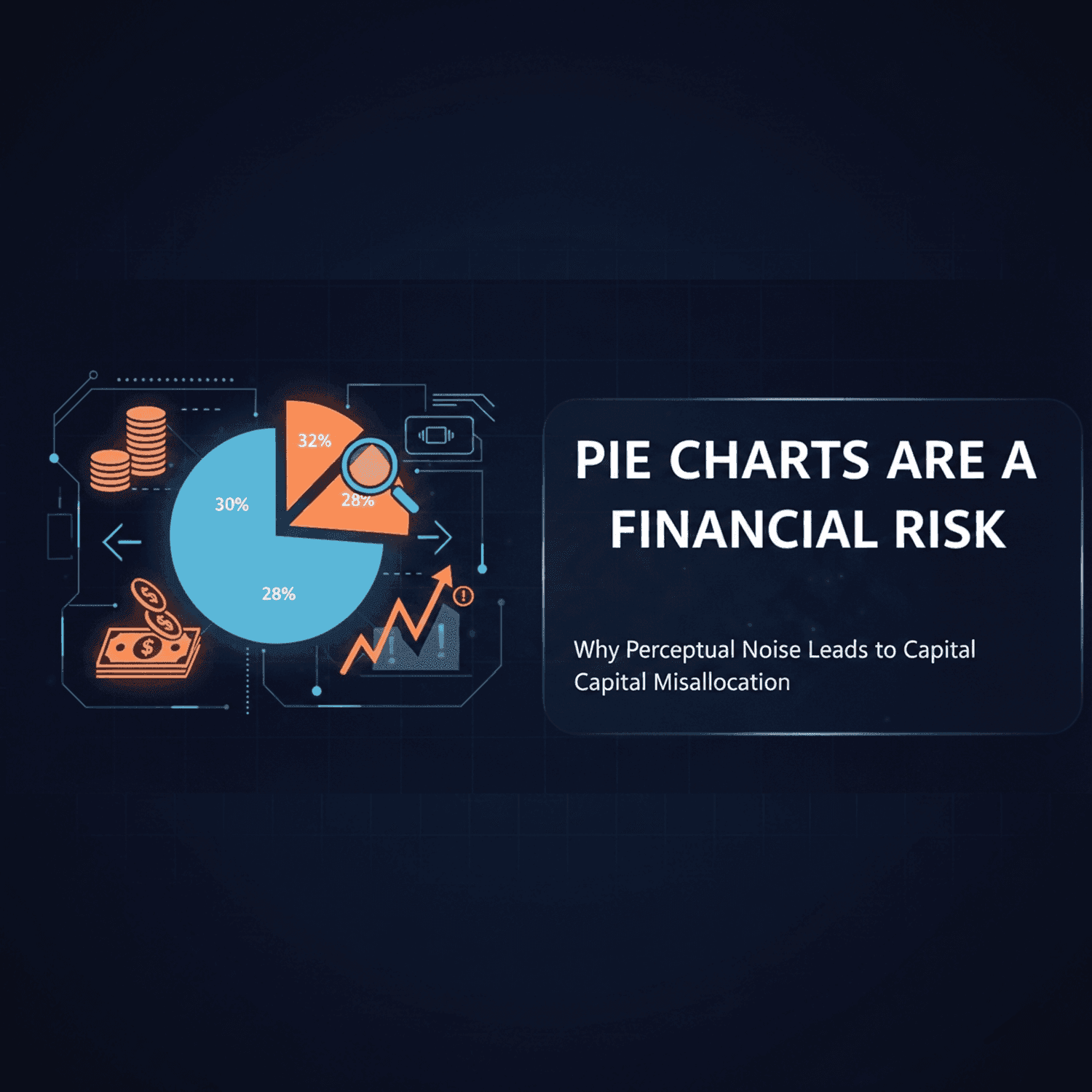
Look at the chart below. Without pausing to analyze, which product line has the highest market share? Which is second?
You likely hesitated. Your brain tried to rotate the blue slice to compare its angle against the orange slice. The cognitive load increased. In a high-pressure environment, you might guess, or worse, assume they are "roughly equal" and allocate capital inefficiently.
Now, look at the exact same data encoded using the correct perceptual hierarchy:
The decision latency drops to near zero. You instantly perceive that Product A > Product B > Product C. The 2% differences, which were invisible noise in the pie chart, become clear signals in the bar chart.
In the pie chart, you were guessing geometry. In the bar chart, you were making a business decision.
From Perceptual Noise to Capital Risk
When executives demand "at-a-glance" dashboards, they are asking for low cognitive load. Delivering a pie chart for critical comparisons is the antithesis of that request.
The risk isn't that a CEO will look at a pie chart and make a massive, obvious error. The risk is framed probabilistically. Perceptual noise increases the probability of misranking marginal differences.
Here is the logical chain of how a bad chart costs money:
- The Channel: A poor perceptual channel (angle/area) is chosen for the dashboard.
- The Variance: This increases estimation variance in the viewer's mind.
- The Misperception: This influences decisions when visuals are the primary input, such as rapid-fire board reviews, slide-driven discussions, or dashboards viewed under time pressure.
- The Compound Effect: Decisions influenced repeatedly by marginal misperceptions lead to small allocation differences compounding over time. At scale, this results in measurable capital flow distortion.
The Plotset Standard: Actionable Mitigations
If your organization claims to value data-driven precision, its visual standards must reflect that claim. Here is a recommended standard for executive reporting that reduces risk:
1. The Precision Rule If an allocation decision depends on differences of ≤ 5 percentage points, use position on a shared scale (e.g., a Bar Chart or Dot Plot in Plotset). Do not use a pie chart.
2. The Comparison Rule When cross-comparison across different regions or products is required, prefer aligned lengths or a single sorted bar chart. Multiple pie charts side-by-side amplify comparison errors.
3. The Annotation Rule If a pie chart must be used (perhaps for a simple 2-slice comparison), always add explicit numeric labels and tooltips with exact values. Labels mitigate, but do not eliminate, reliance on angle decoding.
4. The Template Rule Replace pie chart templates in executive slide decks with stacked or clustered bar templates. Design for the decision context: if the visual is for slide-driven discussion under pressure, default to the clearest encoding.
Conclusion
Keep pie charts for high-level illustrations where exact comparison is irrelevant. But for decisioning, default to position and length. To continue using low-fidelity charts in high-stakes environments is to accept the predictable, cumulative cost of interpretive noise in your business.
Sources
- Cleveland, W. S., & McGill, R. (1984). Graphical Perception: Theory, Experimentation, and Application to the Development of Graphical Methods. Journal of the American Statistical Association, 79(387), 531–554. https://www.jstor.org/stable/2288400
- Cleveland, W. S., & McGill, R. (1985). Graphical Perception and Graphical Methods for Analyzing Scientific Data. Science, 229(4716), 828–833. https://www.science.org/doi/10.1126/science.229.4716.828
- Stevens, S. S. (1957). On the Psychophysical Law. Psychological Review, 64(3), 153–181. https://psycnet.apa.org/record/1959-09865-001
- Tufte, E. R. (1983). The Visual Display of Quantitative Information. Graphics Press. https://www.edwardtufte.com/tufte/books_vdqi
- Heer, J., & Bostock, M. (2010). Crowdsourcing Graphical Perception: Using Mechanical Turk to Assess Visualization Design. CHI 2010 Proceedings.
- Kosara, R., & Skau, D. (2016). Judgment Error in Pie Chart Variations. EuroVis 2016.
- Kahneman, D. (2011). Thinking, Fast and Slow. Farrar, Straus and Giroux. https://us.macmillan.com/books/9780374533557/thinkingfastandslow
- Thaler, R. H., & Sunstein, C. R. (2008). Nudge: Improving Decisions About Health, Wealth, and Happiness. Yale University Press.
The Annotation Rule is the one worth keeping to hand: if a pie chart must be used, perhaps for a simple two-slice split, it needs explicit numeric labels and tooltips with exact values, since labels mitigate reliance on angle decoding rather than remove it. For those cases you can build one from a spreadsheet in the Pie Chart Maker and embed it wherever the report lives, then put the exact figures on it before it reaches anyone making a call. Where the decision turns on differences of five percentage points or less, follow the Precision Rule instead and encode the same data as position on a shared scale.