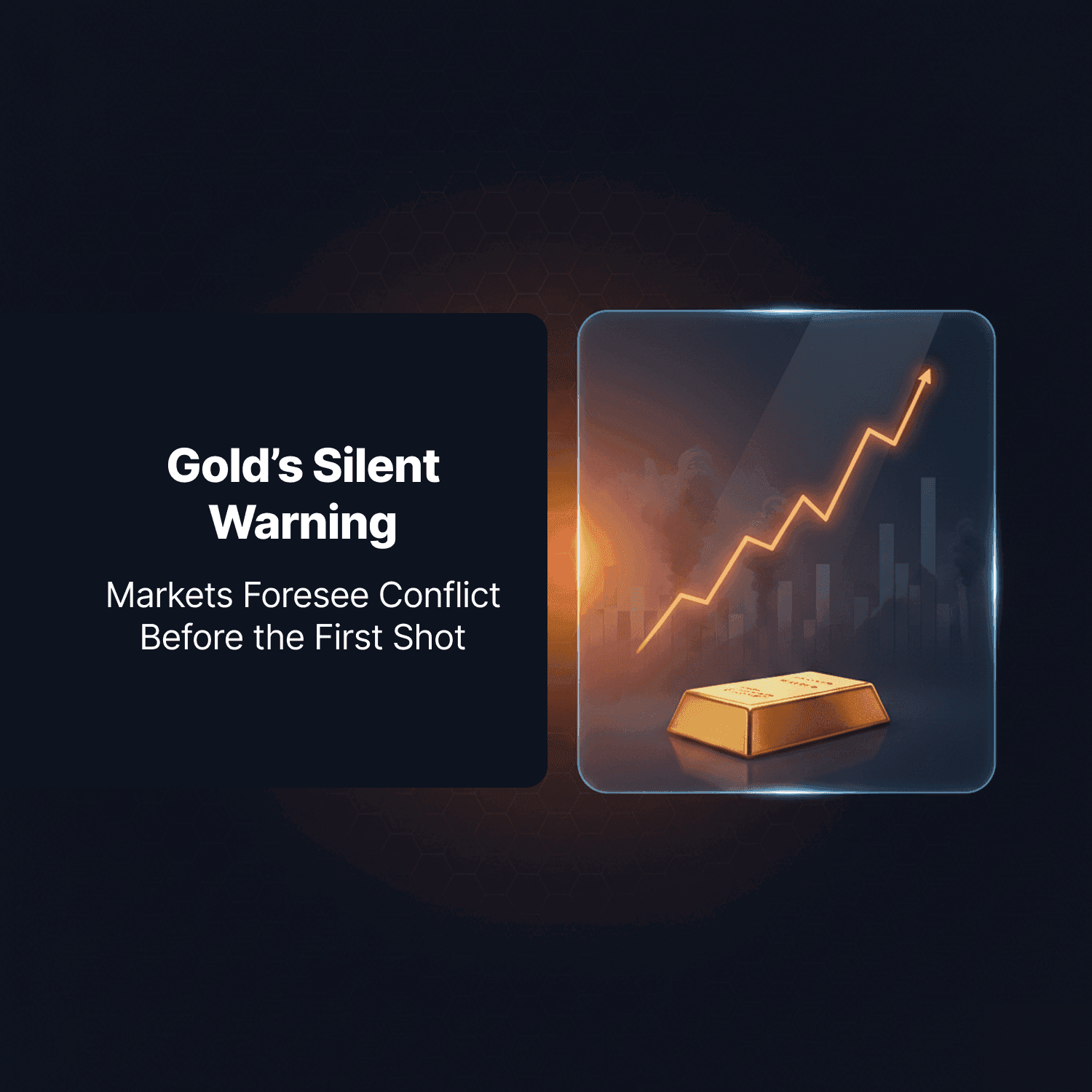
Markets Foresee Conflict Before the First Shot
In the summer of 1990, just weeks before the Gulf War, traders at a London hedge fund watched gold prices surge 12% in a single fortnight. The spike foreshadowed a conflict that would reshape the Middle East, disrupt oil markets, and send shockwaves through global finance. That moment was not an anomaly. Decades of historical data show gold frequently anticipates war, quietly reflecting market anxiety before diplomats or generals take action.
Gold is more than a safe haven. It is the market’s first indicator of tension, a predictive signal for investors, policymakers, and economists alike. Our study of gold futures from 1970 to 2026 highlights a consistent pattern: sharp spikes often precede major conflicts, providing a window into geopolitical risk that few other indicators offer.
Gold and the Wars It Anticipated
Iran–Iraq War (1980)
Before Iraq invaded Iran in September 1980, gold prices were already climbing. Rising oil price expectations, political instability, and military posturing drove investors to the yellow metal. Our war-signal chart shows spikes weeks before the first attacks, as global funds adjusted exposure to geopolitical risk.
"Gold anticipates risk rather than reacts to headlines," says Maria Hernandez, Senior Strategist at Global Capital Markets. "Investors price in uncertainty early, making gold a forward-looking signal."
Gulf War (1990–1991)
When Iraq occupied Kuwait in August 1990, gold surged before the U.S.-led coalition launched its operations. Diplomatic negotiations were tense, while the S&P 500 fell 8% in the month leading up to combat. The gold spike, reaching 12%, reflected concerns over oil supply disruption and global financial stability.
Not all experts agreed. Michael Adler, former analyst at the U.S. State Department, notes:
"Gold spikes do not always predict war. Sometimes they reflect market overreaction or unrelated macroeconomic anxiety. Context is critical."
Afghanistan and Iraq Invasions (2001–2003)
Following the 9/11 attacks, gold again led the narrative. Spikes of 8–9% preceded troop deployments, reflecting investor fear of Middle Eastern instability and broader economic disruption. Bonds and the USD weakened in tandem, demonstrating the interconnectedness of financial markets.
Russo–Ukrainian War (2022–Present)
Gold prices climbed weeks before Russia invaded Ukraine in February 2022. Rising sanctions and troop movements drove a 7–12% surge. Simultaneously, oil prices jumped 10%, while European stock indices dipped 6%. The pattern confirms that gold remains a reliable barometer of risk.
Why Gold Predicts War
Gold responds to uncertainty, fear, and geopolitical risk. Traders, sovereign funds, and central banks watch intelligence reports, military movements, and diplomatic signals closely. Even before formal conflict, gold reflects collective market anticipation.
Historically, it reacts most strongly to:
- Oil supply disruptions in strategic regions
- Direct attacks or invasions
- Threats of regional escalation
Quantitative analysis highlights consistent patterns:
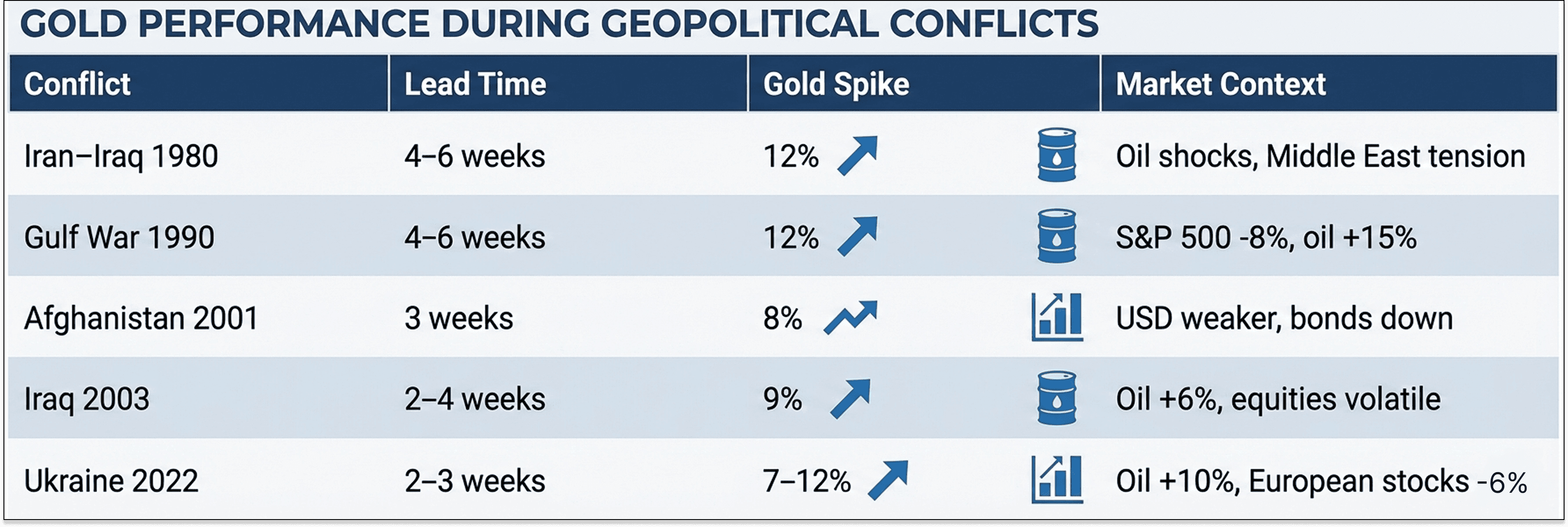
These figures demonstrate that gold anticipates geopolitical risk, often before other financial instruments react.
Forecast: Iran vs United States (2026)
Tensions between Iran and the U.S. are escalating. While no formal war exists, the situation has hallmarks similar to past conflicts:
- Military exercises in the Strait of Hormuz
- U.S. naval deployments signaling readiness
- Prediction markets showing elevated strike probability
- Domestic unrest in Iran adding miscalculation risk
Our war-signal chart shows a moderate but rising spike in gold, echoing historical patterns. Based on prior analogs:
- Scenario 1 – Escalation: Gold +5–15% within 30 days, oil +7–10%, USD weaker
- Scenario 2 – Diplomacy succeeds: Gold remains elevated +3–5%, markets stabilize
- Scenario 3 – Regional spillover: Gold +15–20%, equities drop sharply, oil spikes further
Forecast Box:
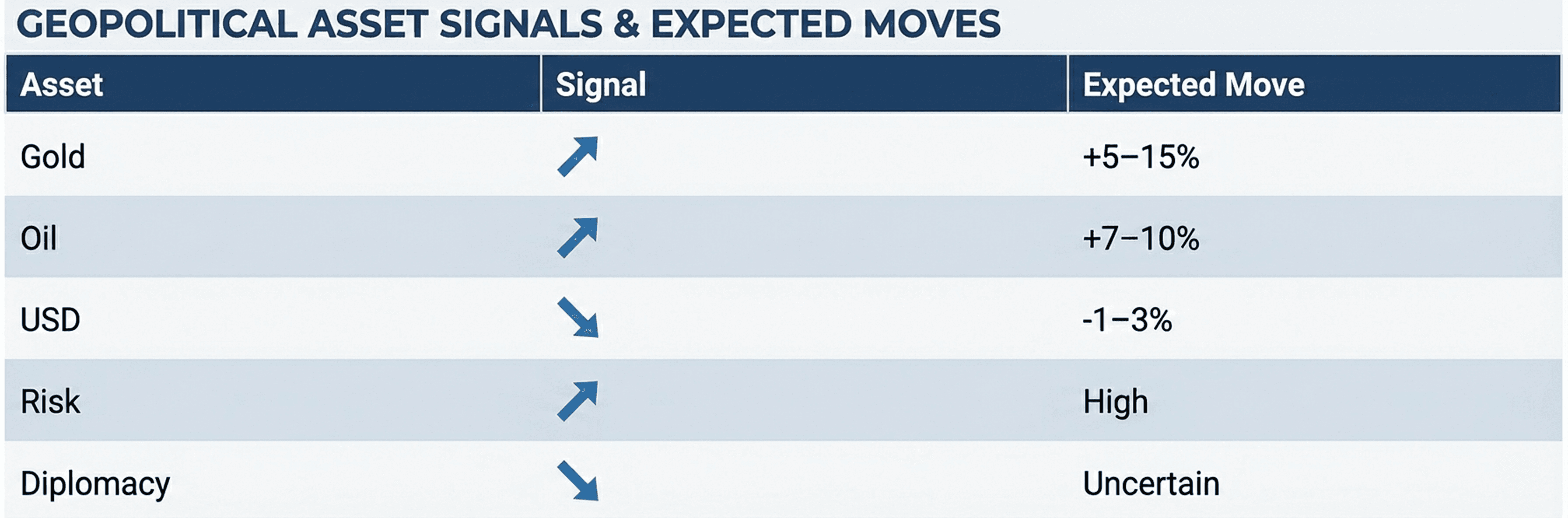
"Gold is the market’s canary in the geopolitical coal mine," says Daniel Roth, Horizon Funds Analyst. "Even without formal conflict, it signals where instability could hit first."
Conclusion
Gold is more than a commodity. It is a market-based early warning system, translating geopolitical tension into actionable financial signals. History shows that sharp spikes precede war, offering investors and policymakers a critical window to anticipate risk.
As diplomacy falters or succeeds, gold continues to speak a language markets cannot ignore. In 2026, its silent warning over the Iran–U.S. standoff may prove as prescient as it has in wars past.