ChatGPT usage is mostly personal, mostly practical and, contrary to its image, rarely about writing code. That is the finding of "How People Use ChatGPT", a working paper from the National Bureau of Economic Research (NBER) and OpenAI economists, which classified a sample of conversations without any human reading them. By July 2025, ChatGPT had more than 700 million weekly users sending over 2.5 billion messages a day, and the paper is the first large look at what they are actually doing.
What do people use ChatGPT for?
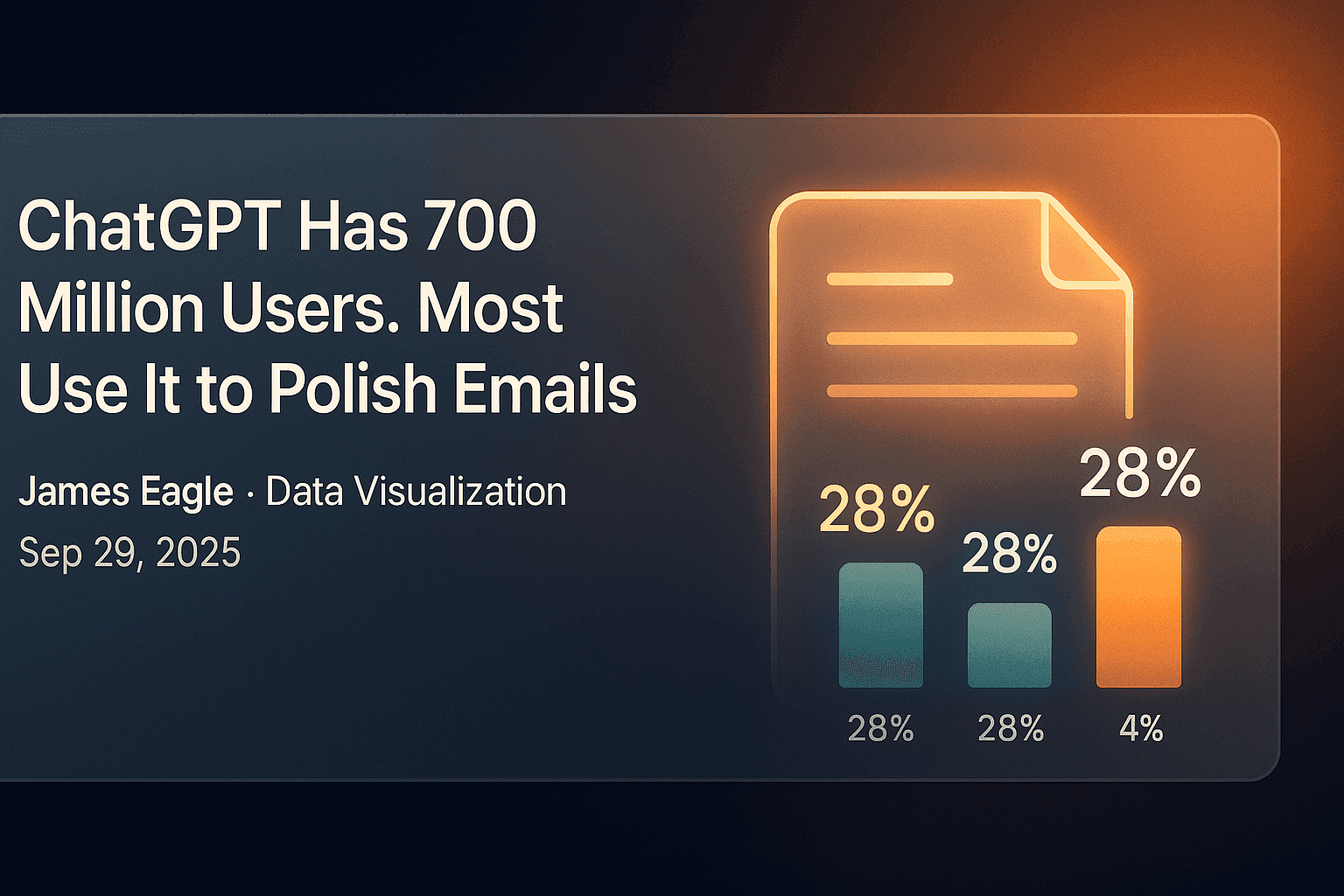
Most people use ChatGPT for practical guidance, finding information and writing. Those three topics account for about 77% of all conversations, according to the paper. Practical guidance (how-to advice, tutoring, ideas) stayed at roughly 29% of use, writing fell from 36% to 24% between July 2024 and July 2025, and seeking information grew from 14% to 24%. Technical help, which includes computer programming, dropped from 12% to around 5%.
The shift is easier to read side by side. Information-seeking, which the authors describe as a close substitute for web search, caught up with writing in a year. Multimedia, mostly image requests, rose from 2% to just over 7%, with a spike after the image-generation launch in April 2025.
Is most ChatGPT use for work?
No. The paper estimates that 73% of consumer messages in June 2025 were not related to work, up from 53% in June 2024. Both kinds grew fast, but non-work messages grew faster:
| Month | Non-work messages per day | Work messages per day | Non-work share |
|---|---|---|---|
| June 2024 | 238 million | 213 million | 53% |
| June 2025 | 1,911 million | 716 million | 73% |
These counts cover consumer plans, and the split is estimated from a random sample of conversations, not read one by one.
Do people mostly use ChatGPT to polish text?
For writing, yes. About two-thirds of all writing messages ask ChatGPT to modify text the user supplied, such as editing, critiquing or translating, rather than to produce new text from scratch. Writing is also the most common work use: roughly 40% of work-related messages.
Two numbers cut against the usual picture of an AI coding assistant. Computer programming is only 4.2% of messages. Relationships and personal reflection is 1.9%. The authors suggest the coding share is low partly because a lot of programming now happens through the API and coding agents, outside the ChatGPT app.
What the study does not tell you
Treat the percentages as well-sourced estimates:
- Consumer plans only. Business and enterprise use is outside the sample.
- Classified by a model. Topics and work or non-work labels come from automated classifiers, which the authors validated against human labels on a public dataset.
- Messages, not people. A heavy user and a casual user count by how many messages they send.
- One company's data. It describes ChatGPT, not AI assistants in general.
When you quote it, name the paper and say "estimated".
How to chart a before-and-after like this
Two time points across a handful of categories is the job of a grouped bar chart. The chart above has one row per topic and one column per year, so the data was a five-row table. Three choices are worth copying:
- Order the categories on purpose. Alphabetical would bury the story. Here the biggest changes (writing, information, technical help) are what the eye should land on.
- Use two clearly different colours for the two years. Keep the same pair on every chart in a series.
- Put the caveat in the footer. The source line on the chart says which numbers were read from the paper's text, so the caution travels with the picture.
For a single year ranked from most to least common, use a bar chart. To show how the work and non-work split moves across many months, a stacked bar chart shows the 100% split directly. If you would rather ask an assistant to build it, connect the PlotSet MCP server and see the Claude integration. Another study on how much of the web is machine-written is charted in AI generates most of what you read online.
FAQ
How many people use ChatGPT?
More than 700 million people used ChatGPT weekly by July 2025, which the paper says is around 10% of the world's adult population. Together they sent more than 2.5 billion messages per day.
What is the most common use of ChatGPT?
Practical guidance, at about 29% of messages, followed by writing and seeking information at roughly 24% each in July 2025. Together the three account for about 77% of conversations.
How much of ChatGPT use is for work?
About 27% of consumer messages in June 2025, down from 47% a year earlier. The remaining 73% were personal or not work-related.
How much of ChatGPT use is coding?
Computer programming is 4.2% of messages in the study. The authors note that much AI-assisted coding happens through the API and dedicated coding tools rather than the ChatGPT app.
Where can I read the study?
The paper is "How People Use ChatGPT" by Chatterji, Cunningham, Deming, Hitzig, Ong, Shan and Wadman, NBER Working Paper 34255, published in September 2025 at nber.org.