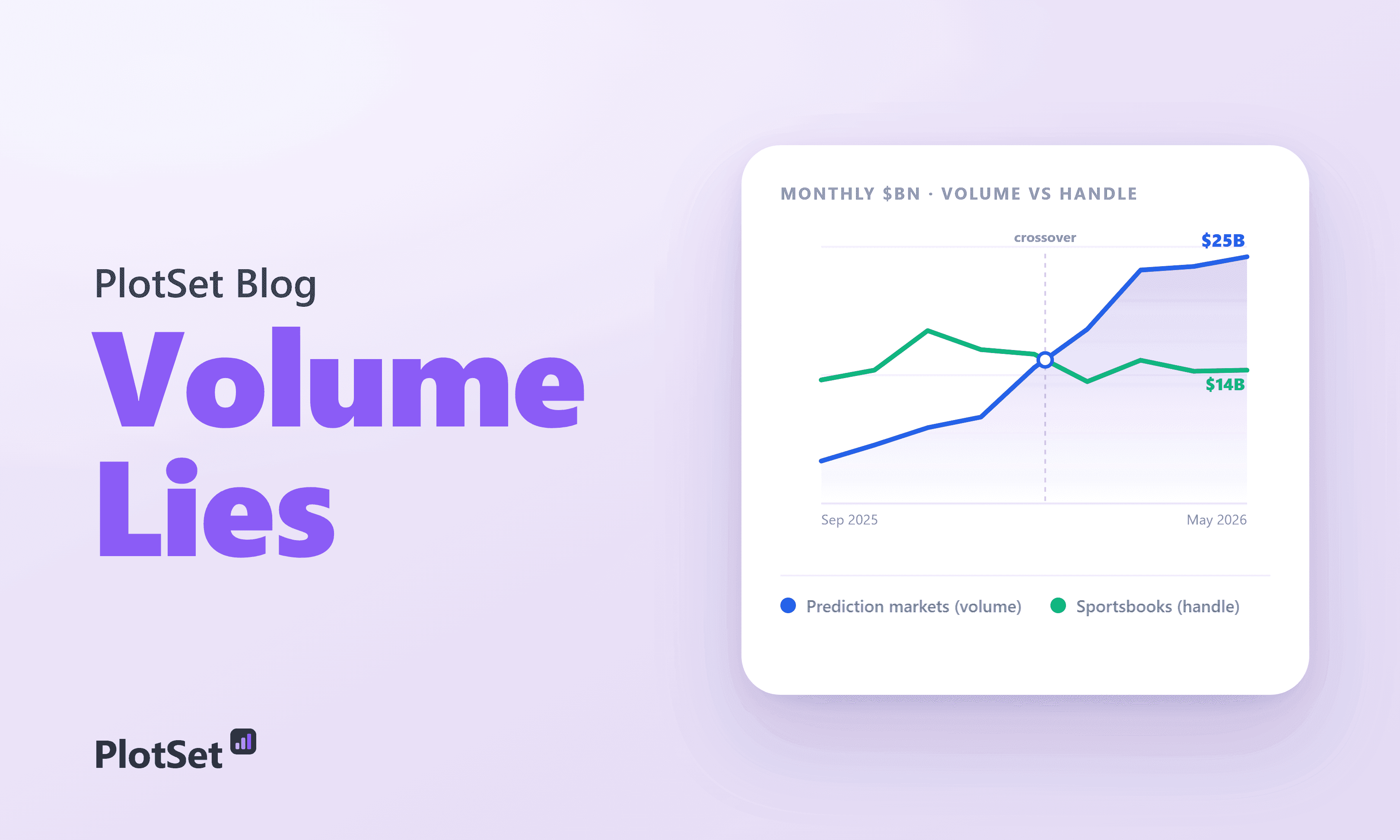
In the spring of 2026, the prediction-market industry crossed a line it had been racing toward for a year. By April, combined monthly trading volume on Kalshi and Polymarket, the two platforms most people still file under "novelty," reached about $24 billion worldwide. That is more than the roughly $14 billion Americans wagered, in a typical month of 2025, across every legal sportsbook in the country. A pair of venues whose combined volume was under $5 billion as recently as September 2025 now appears to move more money than FanDuel, DraftKings, and the entire regulated industry behind them.
The crossover is real. But the word doing the heavy lifting in that sentence is "volume," and it is not the same thing as a bet.
The chart above is the whole story in two lines. The blue line, combined Kalshi and Polymarket volume, sat far below the green sportsbook-handle line through late 2025, then went nearly vertical and passed it around the turn into 2026. By spring it was running at almost double the handle line. If you stop reading there, prediction markets have already won. The rest of this piece is about why you should not stop reading there.
Two words that are quietly different units
The entire debate hinges on three numbers that get used as if they were one. Volume is notional traded value: a contract can be bought and sold many times before it expires, and every trade adds to volume. Handle is the money actually wagered, counted once. Revenue, or gross gaming revenue, is what the operator keeps after paying winners. A sportsbook reports handle; a prediction market reports volume; they are not the same animal wearing different collars.
The trading platform Sporttrade illustrates it cleanly: buy a share at 55 cents, resell it at 60, and you have generated two dollars of "volume" on 55 cents of money ever actually at risk. The sportsbook world has the same gap in reverse. DraftKings disclosed that its 2025 sportsbook ran on something like $2.5 trillion of notional capital at risk against only about $54 billion of real handle, a roughly 46-fold spread. Notional numbers balloon. That is what they do.
The October that never happened
It is worth pausing on when the crossover actually occurred, because a lot of coverage got it wrong. Several outlets dated it to October 2025. The on-chain record says otherwise: combined volume that October was only about $5.9 billion, and November about $7.7 billion, both comfortably under the $14 billion handle line. The first genuine monthly cross came around the late-2025 into early-2026 turn and only became decisive in the first quarter of 2026. Sportsbook handle is also seasonal, peaking in football season and sagging in summer, so the green line wobbles for reasons that have nothing to do with prediction markets.
The ramp behind the line
Underneath the combined line are two very different growth stories, as the chart below makes plain.
Kalshi, the CFTC-regulated exchange, climbed from under $1 billion in August 2025 to a record $17.91 billion in May 2026, its ninth straight monthly record. Polymarket, the on-chain venue, peaked at $10.57 billion in March 2026 and then eased back. Kalshi is now the single biggest money-mover by volume in the entire betting business, and the reason is not exotic: sports. Roughly 80 percent of Kalshi's volume is sports event contracts, spiking above 90 percent during peak NFL and March Madness weeks.
Two very different books
That sports tilt is also the first crack in the comparison.
Kalshi is overwhelmingly a sports book in everything but name. Polymarket is a genuinely mixed exchange, splitting its volume across sports, politics, and crypto. When you stack the headline $24 billion against US sportsbook handle, you are comparing a global, all-category figure (including offshore Polymarket and its political and crypto markets) against a US-only, sports-only one. A clean sports-versus-sports cut shrinks the prediction-market side before the unit problem even enters the room.
Combined Kalshi + Polymarket monthly volume (April 2026) versus US sportsbook handle. But the first number is global notional volume and the second is US money wagered. Different units.— $24B vs $14B
So is it a fair fight?
Here is the steelman, granted in full and then reconciled. Take the volume number seriously and convert it to a handle-equivalent. Sporttrade's own estimates put real money at risk at roughly 45 to 55 percent of volume for single-game markets, and as little as 5 to 20 percent for multi-day events where contracts churn for days. Run $24 billion of volume through that filter and you get something like $5 billion to $15 billion of actual money at risk: comparable to the $14 billion sportsbook handle, not nearly double it.
And then there is the cleanest comparison of all, the one nobody promoting the crossover wants to run. The chart below stacks the inflated volume figure against the measures that actually count.
Revenue. US sportsbooks earned a record $16.96 billion in gross gaming revenue in 2025 on $166.94 billion of handle. Kalshi, by contrast, took in $263.5 million in fees for all of 2025, and Polymarket charged essentially nothing, only reaching a $1 billion annualized run-rate by mid-2026. On the metric that measures who actually runs a bigger business, regulated sportsbooks are still an order of magnitude ahead. The tallest bar in that chart, the $288 billion of annualized volume, is the mirage. The short bars next to it are the business.
The next time a betting-industry headline lands with a giant number attached, ask one question before you believe it: volume, handle, or revenue?
The league table: who really moves the money
Put every venue in one place, sortable, and the apples-to-oranges problem becomes a feature rather than a trap. The Basis column is the honest part: it tells you whether a row is volume or handle before you compare the dollars.
Kalshi's $17.91 billion sits at the top of the table, but it is a volume figure sitting directly above DraftKings' roughly $4.69 billion of monthly handle and FanDuel close behind. The FanDuel and DraftKings duopoly still controls something like two-thirds of every real dollar wagered in America. Sort the table by volume and prediction markets dominate; remember which rows are volume and which are handle, and the picture inverts. That single tension, who leads depends on which "money" you mean, is the real story.
Why the money is chasing it anyway
None of this means the surge is hype. The capital is voting with conviction. Kalshi raised at a $22 billion valuation in May 2026 and is reportedly chasing a round near $40 billion; Polymarket is valued around $15 billion after the New York Stock Exchange's parent ICE committed about $1.64 billion. The regulatory war is just as loud. Dozens of states have sent cease-and-desist letters, Arizona filed the first criminal charges against a CFTC registrant in March 2026, and in April the Third Circuit became the first appellate court to hold that the CFTC has exclusive jurisdiction over these contracts. The fight is over a real prize, with state gaming regulators warning that hundreds of millions in sports-betting taxes are leaking to a federally-regulated, largely-untaxed venue.
The honest bottom line
So did a "novelty" out-trade the entire American sportsbook industry? On the headline, volume versus handle, yes, and that crossover is genuine and fast. On the things that measure a real business, money actually at risk and revenue kept, no, not yet. Eilers and Krejcik model that mature prediction markets could eventually support a handle-equivalent of 60 to 80 percent of today's regulated online sports-betting handle. That is closing fast. It is not past.
The discipline the whole episode demands is small and durable. Before you believe the next giant betting number, ask which money it is counting.
Sources & further reading
- Pew Research Center. Trading volume on prediction markets has soared. Combined volume ~$24B (Apr 2026) up from under $5B (Sep 2025); ~$14B/month sportsbook handle; sports ~80% of Kalshi volume.
- American Gaming Association. 2025 commercial gaming results. US sportsbook handle $166.94B in 2025.
- ESPN. Sports betting hits record $16.96 billion revenue in 2025.
- The Block. Kalshi and Polymarket combined November volume.
- DeFi Rate. Kalshi sets $17.9B May record. Monthly volume ramp.
- Sportshandle. Handle vs trading volume in prediction markets. Sporttrade handle-equivalent conversion (45-55% single-game, 5-20% multi-day).
- Next Event Horizon. DraftKings capital-at-risk vs handle. ~$2.5T notional vs ~$54B handle.
- SEC (EDGAR). DraftKings Q1 2026 8-K. Sportsbook handle (~$4.69B/month).
- Sportico via Yahoo Finance. Kalshi fee revenue 2025. $263.5M, 89% from sports.
- CNBC. Polymarket annualized revenue surpasses $1 billion.
- CNBC. Eilers & Krejcik prediction-market model. Handle-equivalent 60-80% of online sports handle.
- TechCrunch. Kalshi doubles valuation to $22 billion.
- ICE Investor Relations. Strategic investment in Polymarket. ~$1.64B, ~$15B valuation.
- NPR. Kalshi criminal charges in Arizona.
- Holland & Knight. Third Circuit CFTC jurisdiction ruling.